
The short version
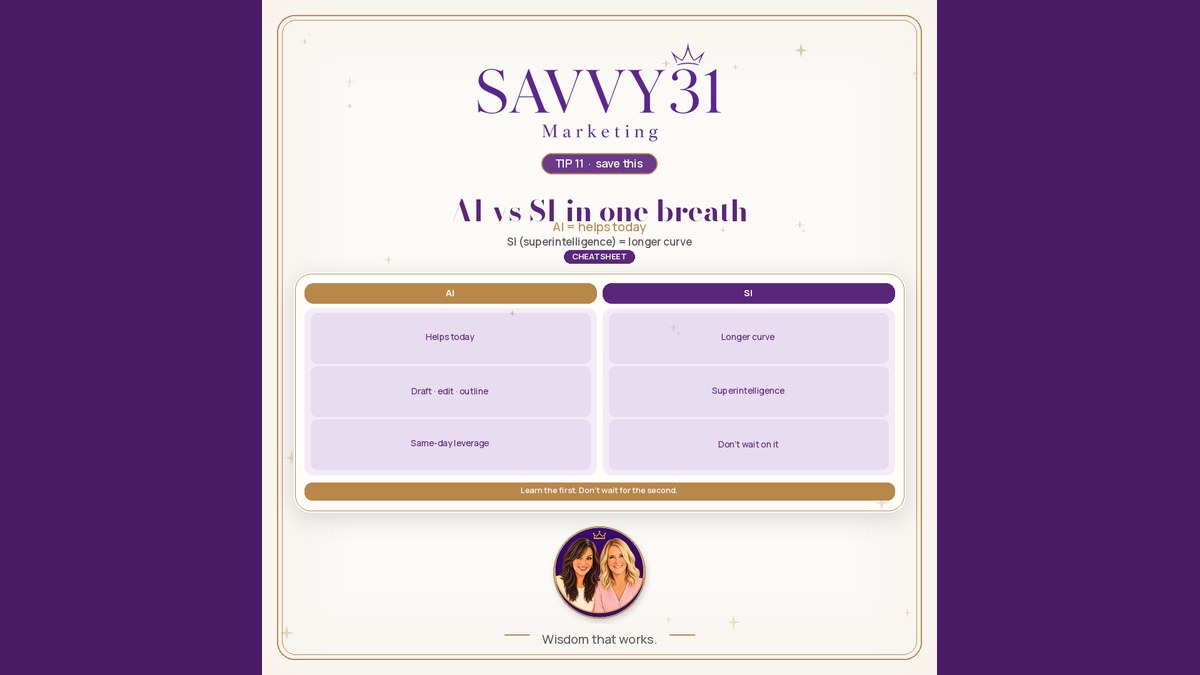
AI is what most of us can use today — helpers that draft, summarize, and speed you up.
SI means superintelligence — a future idea of AI that would far outthink humans. Exciting to talk about. Not what you’re opening on your laptop this afternoon.
If you’re a beginner, start with today’s AI tools.
Save the sci-fi for curiosity — not for your first Tuesday to-do list.
What AI is (in normal words)
AI means artificial intelligence — the assistants and tools available now that can write, sort, suggest, and answer based on patterns learned from lots of examples.
Think of it like a very fast helper:
- Great at first drafts
- Great at “make this clearer”
- Great at checklists and options
It does not automatically know your customer, your values, or what “good” means in your business. You still choose.
Best next move: treat today’s AI like a helper, not a boss.
What SI is (in normal words)
SI here means superintelligence — the big future concept people debate: AI so capable it would outperform humans across almost everything.
You’ll hear SI in headlines, podcasts, and “what if” conversations. That’s fine. Curiosity is healthy.
What SI is not:
- Not the chatbot helping you rewrite an email today
- Not a requirement before you’re “allowed” to learn AI
- Not something you need to build (or fear) before you try one simple prompt
For newcomers: know the word, then come back to tools you can actually use this week.
Where you’ve heard “SI” lately
In September 2026, President Trump said the U.S. would start calling artificial intelligence “super intelligence” (SI) in U.S. documents — arguing that “artificial” makes the technology sound fake. He said it at the U.N. General Assembly (Sep 22, 2026), after floating name ideas on Truth Social a few days earlier.
Coverage if you want the source trail:
- The Verge — Trump says US is officially renaming AI ‘super intelligence’
- The Hill — Trump seeks to rename AI as ‘super intelligence’ in UN speech
- Truth Social poll post (Sep 19, 2026) via Trump’s Truth archive
Newbie takeaway: headlines may say SI. That doesn’t mean you need a PhD before you try today’s AI tools. It’s mostly a label conversation — not a signal that your laptop suddenly got a new kind of brain overnight.
Side-by-side (so it sticks)
| AI (today) | SI (superintelligence) | |
|---|---|---|
| When | Now — tools you can open today | Future / speculative conversations |
| Job | Speed + drafts + options | Far-beyond-human capability (in theory) |
| Question it answers | “Can this help me finish faster?” | “What might AI become someday?” |
| Beginner move | Try one small task with a clear ask | Stay curious; don’t freeze your learning |
| Savvy 31 take | Practical tools | Wisdom that works — don’t confuse the two |
How to use today’s AI well (3 steps)
These are human habits — helpful with any tool. They are not what “SI” means.
- Decide the goal first — Who is this for, and what should they do next?
- Ask AI for a draft or a list — “Make this clearer,” “Give me 5 subject lines,” “Turn this into 3 steps.”
- Edit like a person who cares — Cut fluff, add what’s true, check the tone. Don’t publish the first draft blind.
That’s how you stay in charge — whether the topic of the day is AI tools or big SI headlines.
Tiny examples (business + real life)
Email you dread writing
AI (today): drafts a polite version in 30 seconds
You: soften one line so it sounds like a human wrote it
Website homepage
AI (today): suggests a clearer headline
You: pick the one that sounds like you, not a corporate brochure
When the news mentions SI
Read enough to stay informed
Then return to one practical AI task that helps your business this week
Common newbie traps (skip these)
Trap: “I can’t start until I understand superintelligence.”
Better: Start with one tool and one task. SI debates can wait.
Trap: Treating every AI product like it’s already SI.
Better: Most beginner tools are helpful assistants — powerful, not all-knowing.
Trap: Long fancy prompts you don’t understand.
Better: Short, plain asks. One job per ask.
Trap: Pasting private client details into random tools.
Better: Keep sensitive stuff out unless you know the tool is approved for it.
Trap: Publishing the first draft because it “sounds smart.”
Better: Read it out loud. If you wouldn’t say it to a friend, rewrite.
Your one-week starter plan
- Day 1–2: Pick one recurring task (email, caption, FAQ answer).
- Day 3–4: Let today’s AI draft; you edit for clarity and kindness.
- Day 5: Save the prompt that worked in a note titled “keepers.”
- Weekend: Reuse that keeper once. Celebrate the hour you didn’t waste.
Small wins beat waiting for the future to arrive.
Bottom line
AI = practical help you can use now.
SI (superintelligence) = a future-scale idea — worth knowing about, not worth delaying your first step.
Savvy 31 is here for the practical path — clear next steps, useful tools, and guidance that respects real people. Wisdom that works.
Soft next step
Want help picking one AI task that saves you time without making your brand sound fake?
Start Here on savvy31.com — or email jodi@savvy31.com with one thing you want to simplify.
No pressure. One clear conversation beats another overwhelm spiral.